
AI Agents for Sales, Marketing & Customer Support Explained
Key Takeaways
- Reaching an inbound lead inside the first hour makes a business nearly seven times more likely to qualify it, and that closing window is precisely what AI sales agents are built to defend.
- The dividing line is autonomy: a chatbot reads from a script and quits, while an AI agent chains several steps together (pull a record, fire off a message, write to a database) and decides the next move on its own.
- By 2029, Gartner expects agentic AI to handle 80% of routine service issues on its own, trimming support running costs by about a third.
- Judge an AI agent platform on four things a slick demo hides: which channels it covers, how it plugs into your stack, how it hands off to people, and which languages it speaks.
- Sensitive or legally fraught conversations still trip these agents up, and standing one up takes real configuration time, so keep a person in the loop.
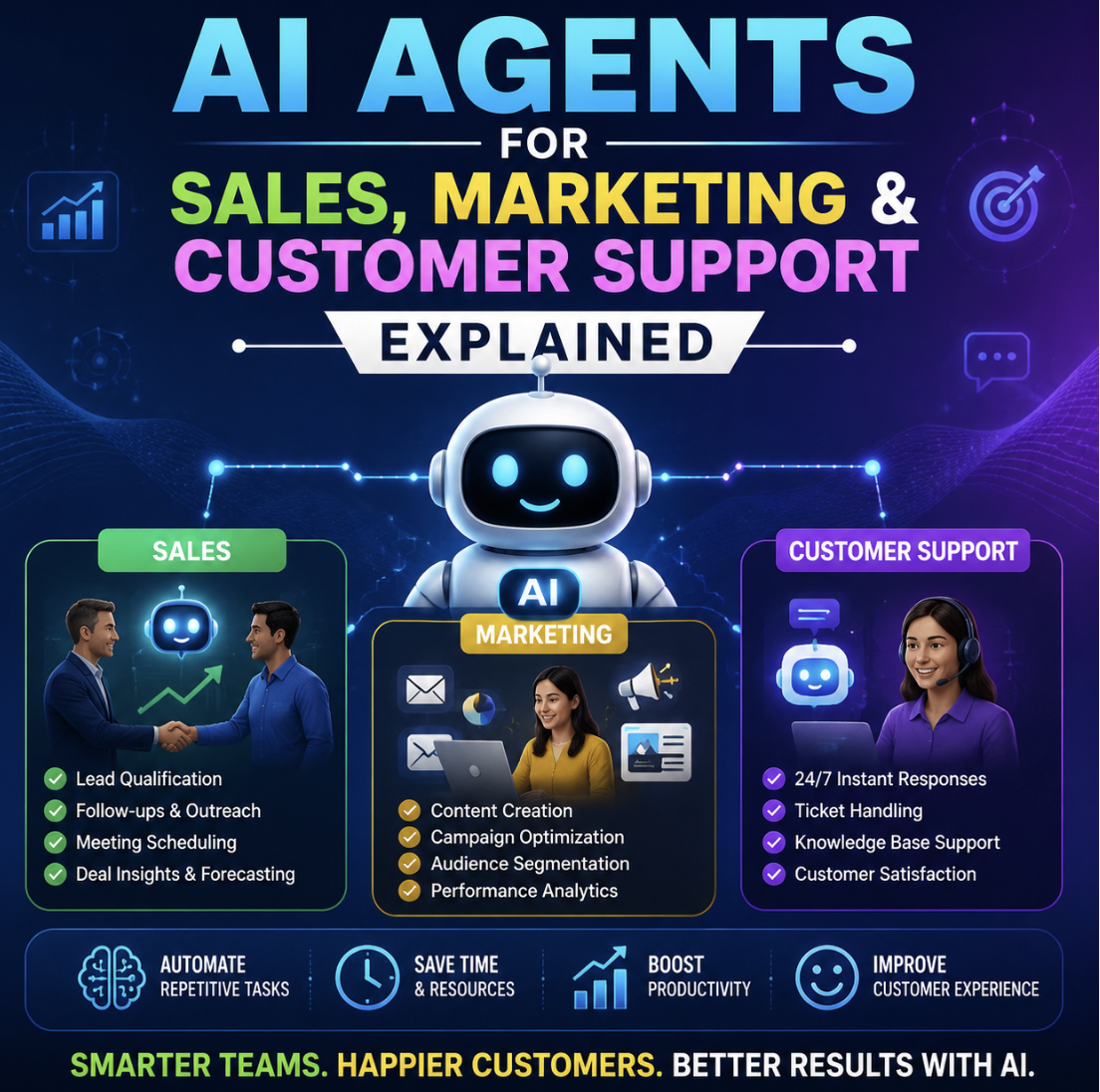
A deal rarely slips away because your product lost a feature comparison.
It slips because a form sat unread for two days, or a weekend question went dark until Monday, and a quicker rival answered first. AI agents for sales, marketing, and customer support were built to shut that speed gap. What follows is a working tour of where they pay off across all three teams, and where they don’t.
Separating an AI agent from an ordinary chatbot
An AI agent is goal-seeking software that strings together several actions without supervision: it can look up an order, message the customer, write the result back to your database, escalate a ticket, then weigh up what to do next. A conventional chatbot walks a fixed decision tree and halts the second a question falls outside it.
You feel the difference the instant a request stops being simple.
Ask a chatbot about a late parcel and it reports the delay, then waits for its next recognised keyword.
An AI agent pulls up the shipping record, locks in the revised date, writes the apology, and attaches a discount code, all before a teammate sees it. Rather than matching your words to a stored reply, it carries out work across whatever systems it’s wired into.
That capability gap, sitting between “recites the FAQ” and “finishes the job,” is why so many teams are rebuilding their workflows around agents.
None of this makes them flawless, and later sections are blunt about the cracks.
Qualifying leads and chasing follow-ups in sales
Sales is the function where minutes turn straight into money, and also where pipelines leak hardest. AI sales agents tighten three of those leaks.
Scoring and routing leads round the clock
The moment a lead lands, an agent can grade it against your criteria and push the strong ones to a rep, no overnight pile-up and no Monday triage marathon.
Why bother chasing seconds?
Research from Harvard Business Review on the lifespan of online leads found that firms reaching a prospect within an hour were nearly seven times more likely to qualify them than those who waited even sixty minutes longer. Few teams hit that mark by hand once the office empties. An agent does it at 3am without blinking.
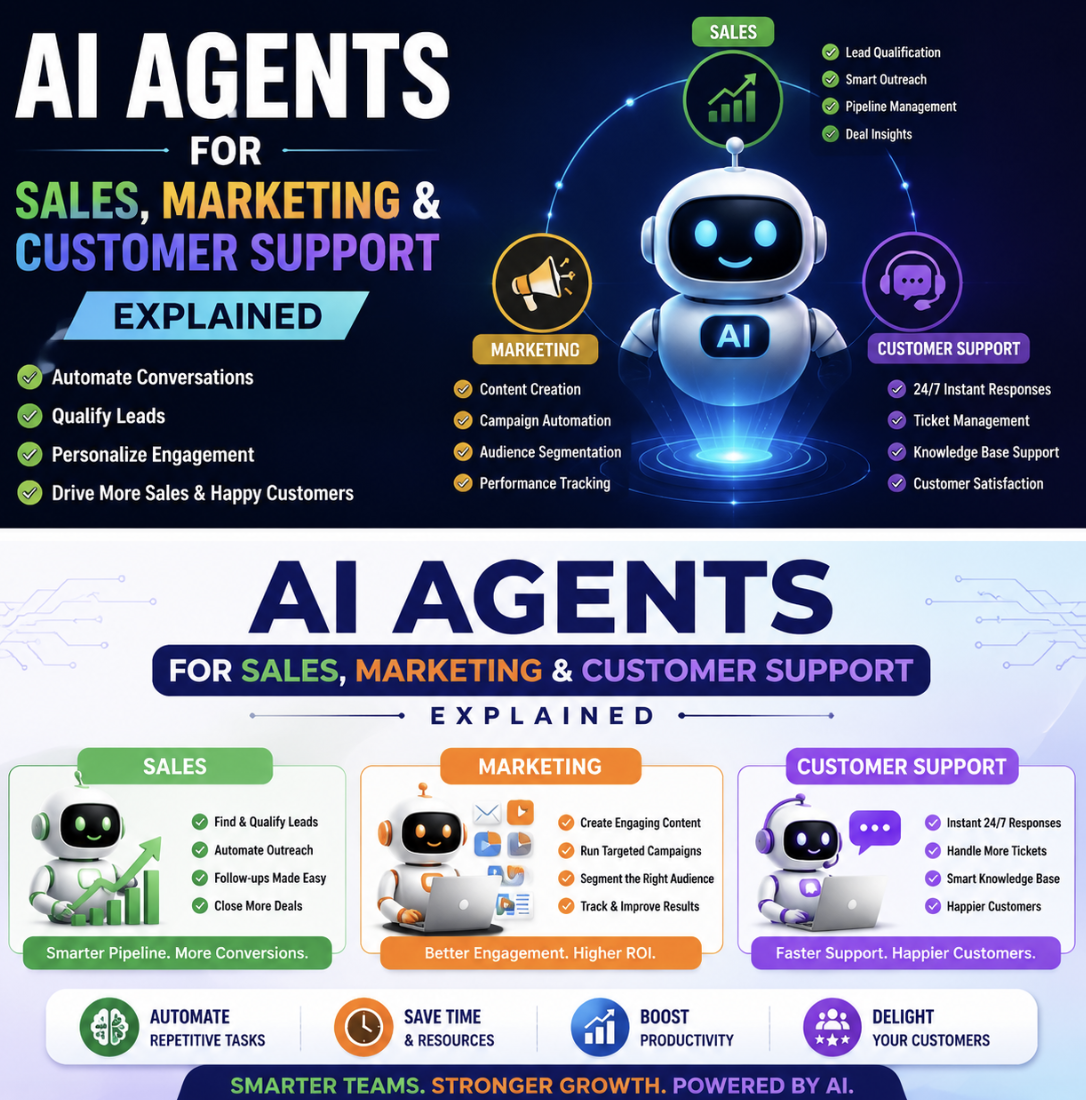
Keeping follow-up sequences alive
Reps let sequences lapse. The third touch slips a mind, or the right moment arrives mid-call. An agent paces personalised follow-ups on a set cadence with nobody minding each thread, then steps aside the instant a prospect writes back so a human picks up the thread warm.
Logging the conversation afterward
Once a chat wraps, the agent files the notes, refreshes the contact record, and marks the next action. The tidy-up reps skip when the day gets loud happens every single time, which is what keeps your pipeline data trustworthy enough to act on.
Reacting inside live campaigns in marketing
Marketing AI splits into two camps: software that builds campaigns and software that reacts inside them. For leaner teams the second camp matters more, because reacting at volume is the chore people simply can’t keep up with past a certain scale.
Segmenting and personalising on the fly. An agent reads how each contact behaves (what they open, click, and buy) and shifts the message or its timing to match, sparing you the chore of rebuilding audiences by hand every time the numbers move.
Running broadcasts and WhatsApp campaigns. If your campaigns live on WhatsApp or Instagram, an agent fires off targeted broadcasts, fields the replies that flow in, and slides interested people into a sales step without a manual baton-pass. That stretch of AI marketing automation covers the unglamorous middle ground between “sent” and “booked.”
Worth saying flat out: a person still has to vet AI-written content before it goes live. That isn’t a flaw in the design. It’s the safety catch that stops one bad message reaching ten thousand inboxes at once.
Answering across every support channel, around the clock
Support feels the strain of thin staffing more than anywhere else, which is where agents make their strongest case. Most of the payoff sits in three jobs.
Fielding the first response
Order status, return rules, account lookups: the same handful of questions, on repeat, all day. An agent fires back answers on the spot with no queue. Gartner forecasts agentic AI resolving 80% of common service issues on its own by 2029, with roughly a 30% cut in running costs. That repetitive tier is exactly what an agent clears without ever bumping a human.
Handing off cleanly when it’s out of its depth
The moment a query outruns what it can manage, the agent captures the full context, sends it to the right team, and drops the whole conversation history in the rep’s lap. Customers skip the part where they repeat themselves. Reps skip the part where they start blind.
Holding one thread across channels
People message on WhatsApp, slide into Instagram DMs, fire off an SMS, and open live chat, frequently about one problem, frequently at once. Agents that span those channels kill the need for a separate tool per inbox. A platform like SleekFlow runs cross-channel AI messaging with contact records baked in, so a chat that opens on WhatsApp and carries on through Instagram stays a single thread against a single customer, not four strangers wearing the same name.
Picking an AI agent platform without getting burned
Every demo dazzles. These are the questions to press a vendor on first, because the answers decide whether a rollout sticks or stalls.
Channel coverage. Does it actually run on the channels your customers message you through, or only the ones featured in the deck?
Fit with your current tools. Will it talk to your email, sales pipeline, and contact database out of the box, or does that hookup turn into a custom build?
Handoff logic. When it reaches its ceiling, does it pass a person the full context, or dump the customer back at square one?
Language coverage. Serving several regions? Check the agent genuinely handles the languages people write to you in.
Pin a vendor down on those four and you’ll read whether an AI agent platform suits you far better than any feature grid ever shows.
Knowing where AI agents still come up short
Anyone promising an agent that does it all is mid-pitch. Two limits hold up.
Emotionally or legally loaded chats. Furious complaints, anything brushing legal liability, moments that call for real empathy and judgment: agents stumble here, and you should fence them out of these on purpose. A human staying in the loop isn’t optional at this tier.
Time to set up and train. An agent only ever matches the data, rules, and flows you feed it. A team with no ops person to spare will need either runway or outside help to get it configured well. Budget for that ramp instead of banking on value from day one.
Neither sinks the case. Both are arguments for starting small.
The teams squeezing the most from AI agents today didn’t switch them on everywhere at once. They aimed one agent at a single job, usually support or sales follow-up, banked the proof, and grew from there. Find the one workflow bleeding you the most in slow replies or dropped leads, and point an agent at that before anything else.
